The Long Story of the Northern Smokehouse
Northern smokehouse traditions paired smoke with salt and drying to preserve food; see how local materials and meals shaped distinct regional flavours.
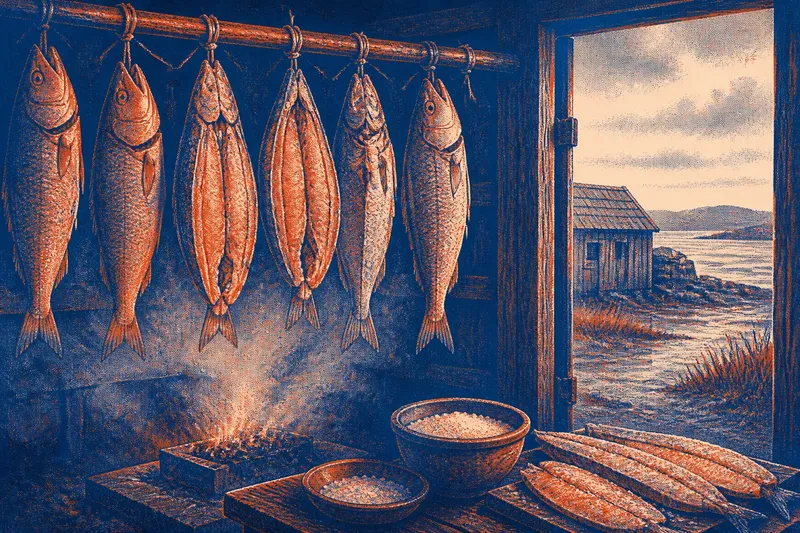
A row of fish hangs above a slow haze in a smokehouse, while outside the weather turns damp and the next catch is uncertain. Northern smokehouse traditions grew in different places and periods, shaped by local food, fuel and household practice. Their shared thread is not one recipe but the use of smoke alongside other ways of preparing and storing food.
Smoke and keeping
Fresh fish and meat can spoil as warmth, moisture and microorganisms affect them. Smoking may contribute to preservation, but it is not a single, all-purpose method. In many food traditions, it accompanies salting, drying and suitable storage.
Salt draws moisture from food; drying removes more. Smoke adds aroma and deposits compounds on the surface, though its effects vary with the food and the process. A smoked product should not be assumed safe to store or eat in a particular way simply because it has been exposed to smoke.
Rather than claim one history for all northern communities, it is more useful to ask what a particular practice was designed to do. Local accounts, museum collections and food histories can help identify the place and period behind a smokehouse tradition; without that context, broad claims about what households commonly did are hard to assess.
Spaces for smoke
Smoking could take place in a sheltered area or a space also used for other household work. In some settings, people built a separate smokehouse to keep food under cover and make room for hanging it. The structures varied with local materials and needs, so there was no single northern design.
Whatever the setting, the work involved more than choosing wood. Food had to be prepared and positioned, and someone had to tend the fire or embers. The distance between food and heat, the movement of smoke and the surrounding conditions all shaped the process.
These practical details also made smoking a learned skill. Repeated work could teach people how a particular food responded to preparation and how local conditions affected drying. That knowledge belonged to particular households and communities, rather than forming a universal set of rules.
Regional ingredients
“Northern” covers coast, island, forest and farmland, each with its own foods, fuels and seasons. In coastal communities, fish might be central; inland, household practice could involve domestic animals or game. Which foods were smoked depended on local access and custom, not on a single regional template.
Herring, salmon, cod and other fish have different shapes and qualities, while cuts of meat also vary. Salt, drying and smoke exposure could be combined in different ways, according to how the food was intended to be used. Names and methods may differ between communities, even when the broad process sounds familiar.
Fuel choices were local, too. Alder, birch and other woods appear in some northern smoking practices, but no wood is right for every place or product. A particular fuel’s availability and customary use matter more than trying to reproduce an isolated detail from elsewhere.
From keeping to flavour
Smoke can give fish and meat a savoury aroma, a darker surface and a distinct taste. Once people knew a smoked food as part of their meals, its flavour could matter alongside its original preserving purpose. The result might be served with bread, potatoes, porridge or another local staple.
Preparation shaped how the food was eaten. Some cured products might be soaked or cooked before serving; others could be used with little further preparation. The right approach depends on the particular product, so its label and maker’s directions matter more than assumptions based on the word “smoked”.
Say a household has a fresh catch it cannot use at once. In this invented situation, its members salt part of the fish, hang it in a ventilated smokehouse and keep that portion for later; the expected observable result is firmer, smoky fish, distinct from the fresh catch. The scenario illustrates a possible sequence, not a claim about how every household worked or how long the food would keep.
Questions about smokehouses?
Did smoking replace salting?
Not necessarily. Smoking may be combined with salting and drying, but the methods used depend on the food and the intended use. No single combination describes every regional tradition.
Was every smokehouse a separate building?
No. Smoking could happen in different sheltered spaces, including places with other household uses. A dedicated structure was one option, not a universal feature.
Why do smoked foods taste different?
Species, cut, salt, drying, fuel and smoke exposure can all affect the result. Serving customs also shape how a food is prepared and experienced at the table.
Is smoked food always ready to eat?
No. Some products are intended to be eaten as sold, while others need cooking or further preparation. Follow the label and maker’s directions, and seek advice from a qualified professional or relevant local authority if you have a food-safety concern.
Local knowledge matters
A smokehouse tradition makes most sense when it is tied to a particular place, food and purpose. Broad descriptions can point to recurring ideas, such as combining smoke with other preparation methods, but they cannot stand in for the history of a specific community.
It is not worth chasing an “authentic” result by copying one wood or ingredient in isolation. Ask instead what the method was intended to preserve, what other steps accompanied it and how people used the finished food. Those questions bring northern smokehouse traditions into focus without flattening their local differences.