The Leftover Trap: Why Saving Every Scrap Can Waste Food
A clear next use makes leftovers easier to keep; learn when to save a remainder, reuse it promptly or let it go without crowding the fridge.
The fridge door swings open, and there it is: a spoonful of gravy in a bowl, two boiled potatoes, a heel of bread and a container no one remembers opening. Saving scraps feels thrifty, but a leftover without a clear next use can occupy space, lose its appeal and eventually be thrown away. A better leftover habit begins with one question: what, specifically, will I do with this?
This is not an argument for discarding good food casually. It is a way to distinguish useful ingredients from hopeful storage. In a northern kitchen, where a roast may be followed by soup and a loaf may be saved for toast, the answer can be wonderfully practical: keep a remainder when it has a destination, and avoid treating every small amount as a future meal.
The next-use test
Before putting anything away, name its next use in plain language. “The potatoes will go into tomorrow’s fish cakes” is a plan. “I might use these sometime” is not. The distinction matters because a named use tells you what the portion is for and helps you decide whether you have enough to make it worthwhile.
Think about three things: whether the food suits a dish you actually cook, whether the quantity is useful, and whether you are likely to want that dish soon. If one answer is no, consider using the remainder now, combining it with something already planned, or letting it go rather than storing it out of guilt.
Say you have half a cup of cooked carrots left after supper. If tomorrow’s lunch is already planned as a vegetable soup, add them to the soup container and label the intended use. If the week’s meals are set and nobody likes carrot soup, the small portion may not earn space in the fridge. The point is not to force a recipe around each scrap; it is to make a deliberate decision while the food and the plan are both in view.
Choose by situation
The same remainder can be worth saving in one household and a poor candidate in another. Your routines, appetite and cooking habits matter more than an abstract rule that all leftovers should be rescued. Use the situation that sounds most like yours.
You already know the next meal
If a meal is coming up that can use the food, keeping it is often straightforward. A portion of roast meat might be set aside for sandwiches, while cooked root vegetables could join a pie filling you have already planned. Store the food in a container that makes its purpose easy to remember, and keep the planned dish realistic rather than aspirational.
It helps to ask whether the amount fits the destination. A single spoonful of sauce may enrich a portion of stew, but it may not be enough to serve as a sauce on its own. If it can be folded into a dish without creating extra work or changing the meal you intended, it has a credible next use.
You cook for one or two
Small households often face the awkward “not quite another meal” portion. A little cooked fish, a wedge of cabbage or a few spoonfuls of beans may be too little for a full serving but useful as part of something else. Consider whether it can join a dish you already make, such as an omelette, a grain bowl or a pot of soup.
If combining it means buying several ingredients or making a special meal you do not fancy, the supposed saving may be mostly theoretical. Keep the remainder only if the addition fits a normal meal and you can identify which one. Otherwise, enjoy what you can with the meal already on the table and do not let obligation dictate the next dinner.
Your week is unpredictable
When work, childcare or travel regularly changes the evening plan, a future meal is less certain. In that case, a container labelled “for Tuesday” may become a small source of pressure. Give uncertain leftovers a flexible but still definite role: “add to a quick lunch” or “stir into the soup if soup is made”, rather than assigning them to a meal that could easily disappear.
Be honest about the kind of food you reach for on busy days. If you tend to choose toast, a ready-made sandwich or something from the freezer, an elaborate leftover that needs chopping and combining may not be the convenient option you imagine. A remainder is more promising when it can be eaten or incorporated with little extra preparation.
You already have several containers
A crowded shelf is a signal to pause new saving, not a reason to stack one more container at the back. Look at the existing food first and choose one item with a clear role in an upcoming meal. If nothing has a likely destination, make room by deciding what to use now and what no longer belongs there.
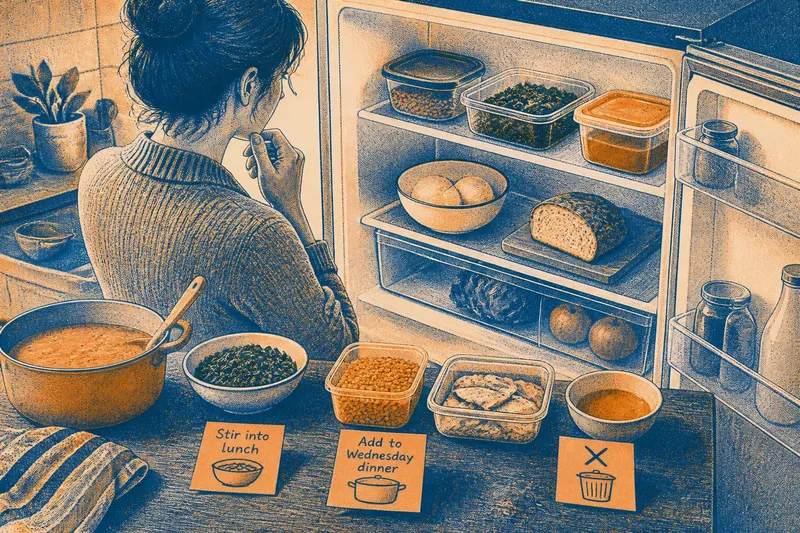
For a deliberately invented situation, imagine a household opening the fridge to find leftover lentils, half a bowl of gravy and cooked greens, but no planned meals that use them. They choose to fold the greens into lunch, add the lentils to a meal already on the calendar, and discard the small gravy remainder they cannot use sensibly. The visible result is a shelf with fewer anonymous containers and two portions attached to actual meals.
Give leftovers a job
A useful container should carry more than food: it should carry a decision. A small label or a note on the container can say “for sandwiches”, “into tomorrow’s soup” or “finish at lunch”. This is not a tracking system that needs elaborate rules; it is a reminder that links the stored portion to a meal you can picture.
Where several foods might work together, keep the intended combination simple. Cooked vegetables can become part of a pie or soup; leftover bread can be toasted or turned into crumbs; a small portion of cooked beans can join a salad or a lunch bowl. These are options, not assignments. A food only has a job if you like the proposed result and can see yourself making it.
Putting a remainder into a meal you are already preparing is often more realistic than inventing a separate recipe. If you are making soup, add suitable cooked vegetables. If you are making sandwiches, set aside the meat or cheese that belongs in them. A tiny amount of a distinctive ingredient may be best used as a flavouring, while a larger portion might be the basis of lunch.
When saving is not useful
Some leftovers have no natural place in your routine. A dish nobody wants again, an awkward quantity that cannot sensibly join another meal, or food that would require a shopping trip may not be worth preserving. Letting go of a portion is not a failure of kitchen craft; it can prevent the same food from being stored, forgotten and discarded later.
It is also not worth the effort to save every garnish, scrape or spoonful in a separate container. A collection of tiny portions can demand more attention than it returns, particularly if each one needs its own label and imagined recipe. Save the scraps that have a clear use, not the ones that merely seem too small to throw away.
For food-safety decisions, follow the storage directions and advice that apply to the food, and use your judgement about its condition. If you are unsure whether a particular item remains safe to eat, consult a qualified food-safety professional rather than relying on smell or appearance alone.
Make the call at the table
The easiest moment to decide what happens to a remainder is often before the dishes are cleared. Ask whether someone wants it for another serving, whether it belongs in a planned meal, or whether it is simply a small amount with no likely destination. Making the call then avoids transferring food into a container by reflex.
That pause can also distinguish leftovers from ingredients you intentionally set aside. If you are cooking for a larger meal, you may portion extra food for a specific lunch before serving. That is planned cooking, not a promise to rescue every plate scrap. Keep the portion you mean to eat and leave the rest of the decision uncomplicated.
Leftover questions?
How do I decide whether to save a leftover?
Name a meal or use for it, then ask whether the quantity fits and whether you are likely to make that dish. If you cannot identify a plausible next use, do not store it simply because throwing food away feels uncomfortable.
What if the portion is too small for a meal?
See whether it can join a dish already on your menu, such as soup, an omelette or a lunch bowl. If using it would require extra shopping or a separate recipe you do not want to make, it may not be a useful leftover.
Should I save food I might eat later?
“Might” is a weak plan unless you can connect it to a familiar meal or a likely occasion. Give it a flexible purpose you genuinely use, such as a quick lunch, and avoid keeping it if that role does not suit your routine.
How can I stop leftovers being forgotten?
Put the container where you will see it and write its intended use on a label or note. A short reminder such as “for lunch” is more helpful than a vague container that requires you to remember what it is and why you kept it.
A calmer fridge habit
Keeping food thoughtfully is less about collecting every remainder and more about making the next meal easier. The next-use test gives each saved portion a reason to be there, while leaving room to use, combine or release food that does not fit.
Try asking the question once tonight: what is this for? If the answer is clear, store it with that purpose in mind. If not, enjoy what you can now, make another sensible choice, and let your fridge reflect the meals you actually plan to eat.